"It makes them look beautiful."
On April 5, photographer and filmmaker Khalik Allah visited George Mason University to present his documentary, Field Niggas, and discuss his art, the spiritual center of his work, and his approach to his subjects. Our discussion was facilitated by Ann Hornaday of the Washington Post and Wendi Manuel-Scott, director of African and African American Studies at GMU.
On Wednesday, April 6, Allah joined a group of students for lunch, including members of GMU's Delta Kappa Alpha and Black Student Alliance. He spoke of his childhood on Long Island, the digital filmmaking course he took at college, his nights working at AMC network, and the years he spent making Field Niggas. Asked about his current projects, he said mentioned a recent two-day shoot he'd done for Beyonce. He smiled, then told us he wasn't sure what might come of it... then said nothing more.
 Two weeks later, we learned that Allah was one of the cinematographers and second unit director for Lemonade. Imagine how hard it was to keep that secret.
As Ann Hornaday writes in the Post, one of the many ways that "Beyoncé perfected the ‘visual album’ with ‘Lemonade’," was to collaborate with gifted, original "of-the-moment filmmakers" such as Khalik Allah.
The 31-year-old artist, raised in Brookhaven, Long Island, inspired by hip-hop (it's "an education," he says) as well as photographers like Nobuyoshi Araki, Daido Moriyama, and Gordon Parks, sees his work as a means to many ends, helping his subjects to share their experiences, providing light for both subjects and viewers, finding a range of self-expressions. Field Niggas documents his interactions with people on the corner of Harlem's 125th Street and Lexington Avenue, many of them homeless and addicted to drugs and alcohol. As Khalik said during the Q&A following the screening at GMU, he uses his camera to reveal the beauty in everyone, to help viewers understand what they share with people they might assume are "other."
The day after the screening, Khalik spoke with Sue Wrbican's Documentary Photography class (AVT 457). He shared his work, remembered how he came to know the interviewees in Field Niggas, including a longtime collaborator named Frenchie (now deceased). and encouraged students to consider the perpetually blurred boundaries between art and documentary. While at GMU, Khalik also sat down for a Cameo interview, a DKA production, with special guest host Nicole Cross, Public Relations Chair for BSA.
Allah's's work for Lemonade and in his own documentaries (one of his next projects has taken him back to Jamaica, where he has family) is consistently provocative, urging people to consider the way they interpret and judge what they see. As Hornaday writes in "Bold films negotiate the fine line between voyeurism and bearing witness," “'Field Niggas' makes a powerful claim for the dignity and visibility of its subjects, even as it travels to precincts far outside their purview. What could have been an example of “ethnographic” documentary at its most patronizing instead becomes an opportunity for radical engagement -- thanks to Allah’s reflexive eye for humor, pathos and beauty, his willingness to interact unguardedly with his subjects on-screen, and a non-synchronized sound design that demands more of the audience than passive onlooking."
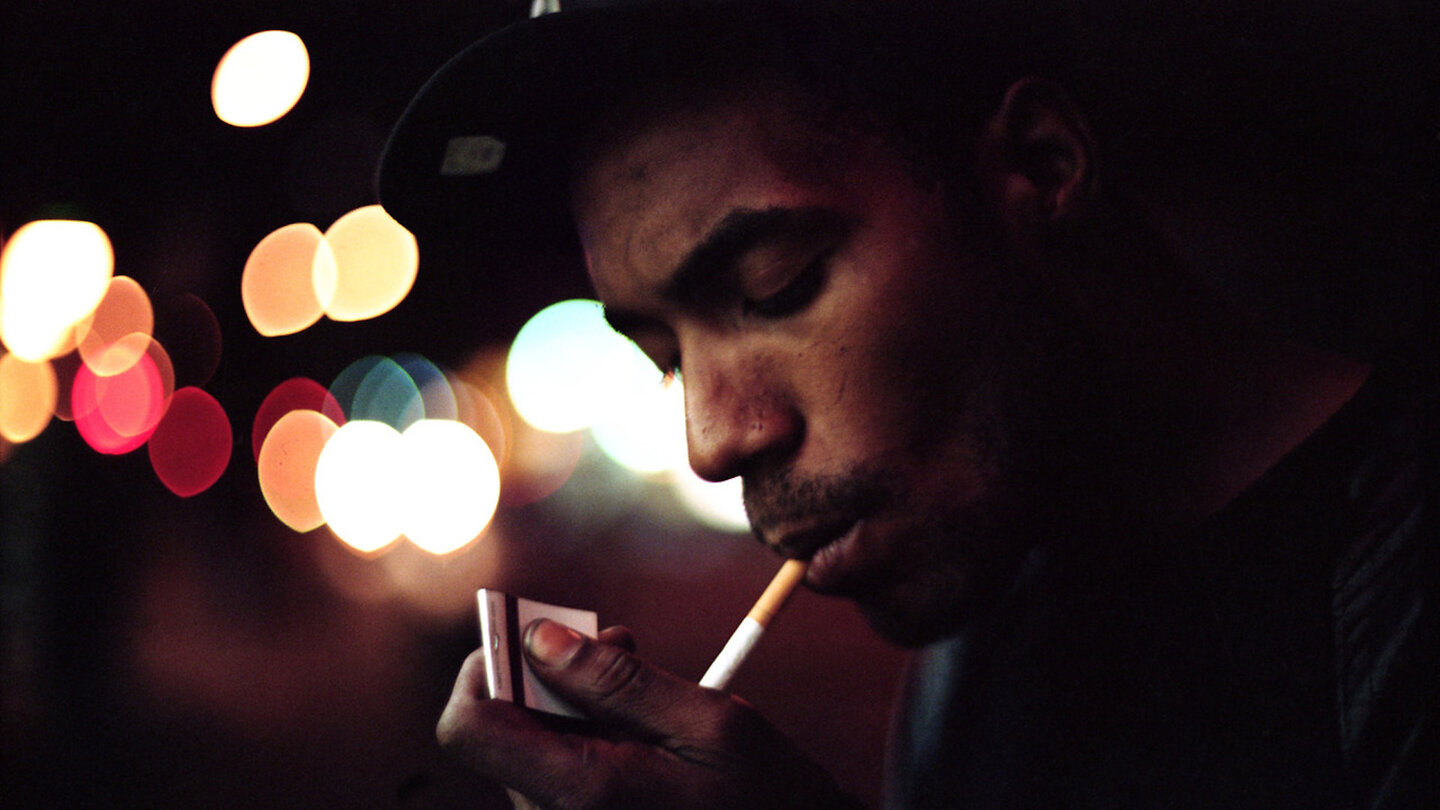 In order to encourage that participation, the film is provocative, beginning with its title. Khalik Allah tells the LA Times, "I was in a rebellious mentality while I was making the film [during the summer of 2014]. ... [M]y superheroes are Denmark Vesey and Nat Turner, slaves who fought against the master and led rebellions."
Speaking with Filmmaker Magazine, Khalik Allah explains that as a documentary filmmaker, he means to be "disarming" and also, open to experiences. For instance, when he encounters police officers during his filming on the streets of New York, he says, "While I’m aware of what many police have done and continue to do across America, psychologically we are very vast, and so I wouldn’t make the mistake of defining anyone by their behavior. The power is in me to free them from their behavior by seeing them differently. I focus on what I want to see and forgive the rest."
Images can initiate conversations, pose questions, and inspire self-awareness. Khalik Allah's "Camera Ministry" is alive and breathing, visible and visceral, in Field Niggas and also in the street interview images he shot for Lemonade (see on TouTube) -- a film that also draws on Malcolm X, his sampled voice reminding us, "The most disrespected person in America is the black woman." Grainy and gorgeous, Allah's images of people looking into the camera, looking at you, appear throughout Lemonade. Much like the portraits in Field Niggas, these offer a new way to think about art and politics, to see yourself as well as others.
See also, GMU IV Estate's article on Khalik Allah's visit, by Basma Humadi.
Thank you to everyone who helped to create our special event at GMU: African and African American Studies, Film and Video Studies, GMU Black Student Alliance, GMU Delta Kappa Alpha, the English Department, Cultural Studies, and University Life. Thank you also to G Chesler, Kristin Samuelian, Mika'il Petin, Latoya Mason, Aja Clark, Nicole Cross, Sue Wrbican, and Rebekah Mejorado.
Event photos by David Mason, GMU Film and Video Studies Program.
Photo collages by DKA.
See more of Khalik Allah's work on YouTube.